
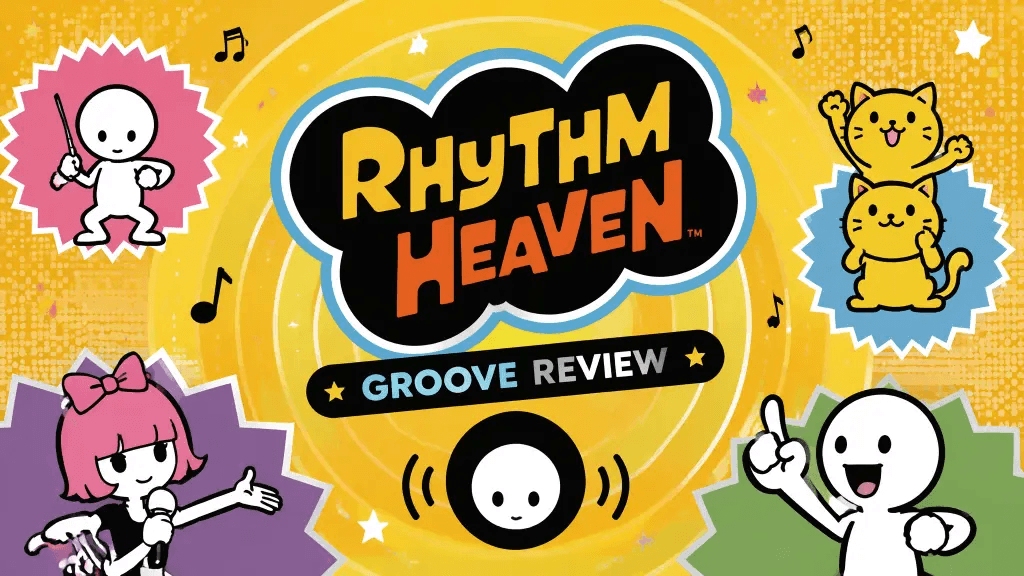
Rhythm Heaven: Groove marks a welcome return for Nintendo's long-running rhythm series, delivering a collection of inventive music-based minigames that strip the genre down to its essentials. Rather than relying on complicated controls or dense note charts, the game focuses on timing, asking players to trust their ears more than their eyes.
That philosophy sets Groove apart from many rhythm games. While titles such as Guitar Hero, Beat Saber, or the Persona dancing games often challenge players with increasingly complex inputs, Rhythm Heaven limits every minigame to no more than two buttons, with most requiring only one. The challenge comes entirely from maintaining precise rhythm instead of memorizing button combinations.
The campaign is built around 16 stages, each featuring four rhythm minigames before culminating in a Remix stage that combines previously learned mechanics into a single performance. Every activity lasts only a few minutes, making repeat attempts feel natural while ensuring Perfect rankings remain rewarding rather than accidental. Groove also encourages accurate timing, even recommending handheld play to reduce input latency.
Although the controls remain remarkably simple, the variety is impressive. Players might imitate drum beats in one challenge, synchronize movements with dancers in another, dodge lightning to a musical rhythm, or communicate with aliens through carefully timed inputs. Every minigame introduces a new concept while staying faithful to the series' minimalist design.
One standout example is A for Effort, where players press the A button whenever the letter "A" appears within scrolling words such as "TEA," "SODA," and "COCOA." Each word arrives with different timing based on its length, while distracting visual gags attempt to pull attention away from the rhythm. Later variations increase the difficulty by introducing strings of repeated letters, further emphasizing precise timing over visual reaction.
Groove also expands beyond its main campaign with additional content. Players can unlock WarioWare-style microgames, experiment with sound-based activities, enjoy multiplayer-exclusive minigames, and even replay the interactive credits sequence. An RPG-inspired mode called Beatspell adds another layer of variety by having players cast spells to a metronome, later introducing 3/4 time signatures alongside the standard 4/4 rhythm to create fresh timing challenges.
Throughout the experience, Rhythm Heaven: Groove demonstrates how much variety can be created using only a handful of inputs. Rather than overwhelming players with mechanics, the game continually finds new ways to reinterpret its simple formula.
The experience also draws comparisons with Tetris Effect, though the two games approach music differently. In Tetris Effect, gameplay generates the musical experience as players interact with the puzzle. Rhythm Heaven reverses that relationship, allowing music itself to dictate the gameplay. Success depends less on watching the screen than listening carefully to audio cues, making rhythm the true centerpiece of the experience.
For players with an interest in music, Groove offers more than entertainment. Its collection of roughly 80 minigames gradually introduces concepts such as timing, syncopation, and changing time signatures in a way that feels surprisingly educational without sacrificing accessibility.
Verdict
Rhythm Heaven: Groove successfully revives Nintendo's rhythm franchise by proving that compelling rhythm gameplay doesn't require complex controls. Its inventive minigames, memorable soundtrack, and remarkable variety turn a minimalist control scheme into one of the genre's most creative experiences. Whether approached as a rhythm game or simply as a celebration of music, Groove stands out as one of Nintendo's strongest releases in years.