
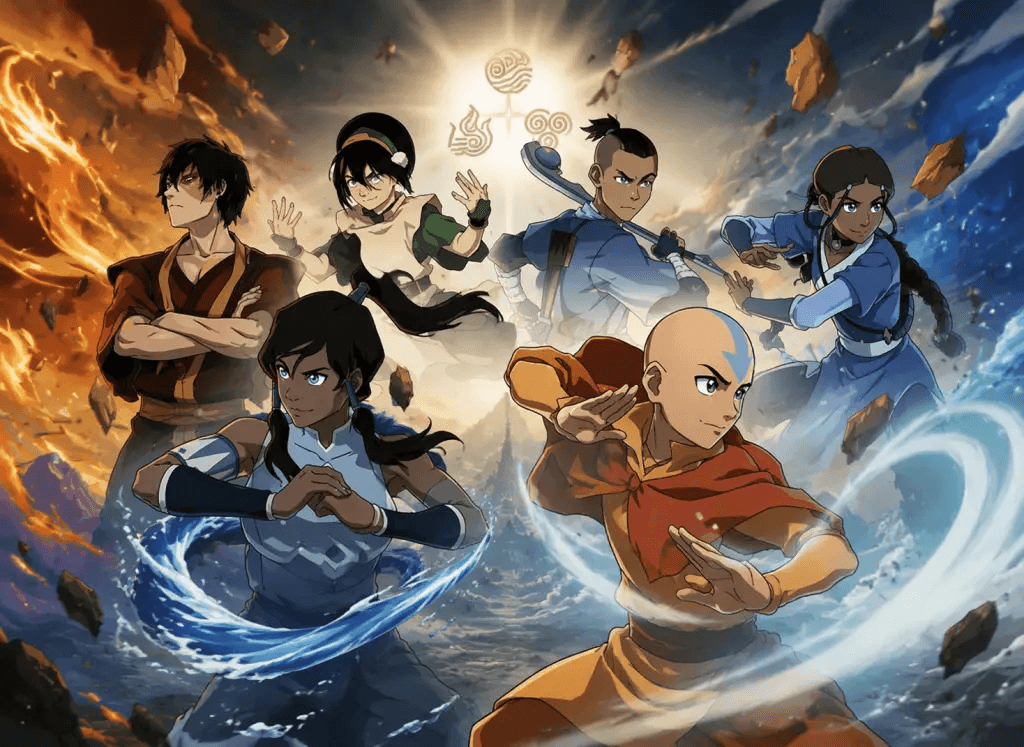
Avatar Legends: The Fighting Game delivers one of the most ambitious interpretations of the Avatar universe in fighting game form. Its fast movement, expressive combat system, character-specific mechanics, and impressive animation make it a standout 1v1 fighter with a strong foundation.
However, while the core gameplay is remarkably polished, several surrounding features feel incomplete. Missing difficulty options in single-player modes, limited training tools, and restricted online lobby functionality prevent Avatar Legends from reaching its full potential.
Like the heroes at the beginning of their journeys, Avatar Legends arrives with a powerful identity but still shows signs of needing further refinement.
A Fighting System Built Around Movement and Creativity
At its core, Avatar Legends is a fast-paced, mobility-focused 1v1 fighting game designed around creative combo expression and character individuality.
Unlike fighters that rely heavily on universal mechanics, Avatar Legends places most of its depth in the unique abilities of each character. The result is a system with a high execution barrier, where mastering even a portion of a fighter’s potential can create extremely rewarding moments.
The basic controls are approachable. Players have three attack buttons covering light, medium, and heavy attacks, alongside a unique “Flow” button connected to each character’s movement abilities.
Like many anime-style fighting games, the combat system follows familiar combo structures, allowing players to chain attacks from lighter strikes into heavier attacks and special moves. There is also an auto-combo option for newcomers who want a simpler way to participate.
But the Flow system is where Avatar Legends separates itself from traditional fighters.
The Flow System Defines Every Character
Every fighter in Avatar Legends has a completely different approach to movement, and the Flow mechanic allows characters to break the normal rules of traditional fighting games.
Aang, for example, can use forward Flow to perform a quick movement option with multiple follow-ups. In the air, his Flow abilities allow him to use his glider, manipulate his movement direction, or quickly descend toward the ground, creating unpredictable approaches and combo opportunities.
Other characters take the system in completely different directions.
Azula can perform multiple air dashes in different directions, allowing her to control space in unusual ways. Toph can manipulate earth-based abilities to pull opponents closer or reposition herself. Katara can charge special moves while sliding across the battlefield, creating unique offensive options.
Each fighter has their own way of interacting with the movement system, making the roster feel more diverse than its size suggests.
Character Design Reflects the Avatar Universe
One of Avatar Legends’ strongest elements is how closely each character’s gameplay reflects their personality and abilities from the original series.
Korra’s aggressive and powerful fighting style mirrors her confidence and impulsive nature. She can deal significant damage through high-impact combos, but many of her strongest tools come with additional risks, requiring careful resource management.
Azula features two separate forms: Focused and Firelord.
The Focused version represents her controlled and precise personality, with a playstyle built around timing-based techniques and accurate execution. Her Firelord form reflects her instability and overwhelming aggression, trading precision for stronger close-range pressure and greater damage output.
These differences make each version of the character feel distinct rather than simply functioning as alternate costumes.
Resource Management Adds Another Layer of Strategy
Beyond the Flow system, Avatar Legends also features an energy meter used for enhanced special moves and super attacks.
Instead of gradually filling through damage dealt or received, the meter is divided into individual segments. Players can only gain a limited amount of energy during a single combo, while additional methods such as character-specific critical hits provide alternative ways to build resources.
This creates constant decision-making during matches.
Players must decide when to spend their resources for immediate damage and when to preserve them for future opportunities, adding another strategic layer to the combat system.
Support Characters Expand a Smaller Roster
Although Avatar Legends features a relatively limited main roster, the game expands character customization through support characters.
Before each match, players can select from three support options that modify aspects of their fighter’s abilities. These choices can enhance specific special moves, introduce new options, or improve movement techniques.
The system creates additional variation and allows characters to approach matches in different ways.
A Strong Combat System Surrounded by Missing Features
While the fighting mechanics are the highlight of Avatar Legends, the rest of the package feels less complete.
The story mode features an original storyline developed with involvement from Avatar creators, including Michael Dante DiMartino and writer Tim Hedrick. The campaign presents an alternate scenario involving familiar characters in unexpected situations.
Although the voice performances are strong and the story includes references that longtime fans may appreciate, the narrative struggles to maintain momentum across its 27 chapters. The alternate universe concept provides opportunities for interesting interactions, but the campaign does not always take full advantage of them.
Outside of the story mode, single-player options are also limited.
Arcade mode does not include adjustable AI difficulty, meaning players cannot fine-tune the challenge level based on their preference. For a fighting game that emphasizes both accessibility and competitive depth, this creates a noticeable limitation.
Training Tools Need More Refinement
Avatar Legends includes several useful features for players looking to improve. Frame data information is available directly, and hitbox visualization helps players understand attack ranges and vulnerabilities.
However, the training mode itself lacks some expected quality-of-life features.
Simple tasks, such as setting training dummies to perform specific defensive actions, are more complicated than they should be. The absence of random blocking options also makes practicing hit confirms more difficult.
The game does provide strong combo trials and character-specific tutorials. A Breakdown feature allows players to learn combos step by step by freezing the action between inputs, helping newcomers build muscle memory.
The character tutorials are particularly valuable because they focus not only on performing combos but also on understanding how each fighter applies pressure, creates openings, and handles defense.
Online Play Is Smooth, But Missing Key Features
Online performance is one of Avatar Legends’ strongest technical areas. Rollback netcode provides stable matches, while fast rematches, quick loading, and easy returns to practice mode create a smooth competitive experience.
However, several expected online features are missing.
The biggest issue is the lack of larger player lobbies. Matches currently support only two players, preventing groups of friends from creating rooms where multiple players can rotate matches and spectate.
Additional features such as replay searching and replay takeover are also unavailable, limiting opportunities for players to study high-level matches and improve.
Some of these features are planned for future updates, but their absence at launch leaves the online experience feeling incomplete.
Verdict
Avatar Legends: The Fighting Game succeeds where it matters most: its combat system.
The combination of character-specific movement, creative combo possibilities, resource management, and faithful character design creates one of the most distinctive fighting systems inspired by the Avatar universe.
Its problems come from everything surrounding that foundation. Limited single-player options, incomplete training tools, and missing online features prevent the game from delivering a fully finished package.
Avatar Legends has the mechanics of a great competitive fighter. What it needs now is the additional polish and features required to match the strength of its core gameplay.
For fans of Avatar and fighting games alike, it represents a promising beginning—but one that still has room to grow.