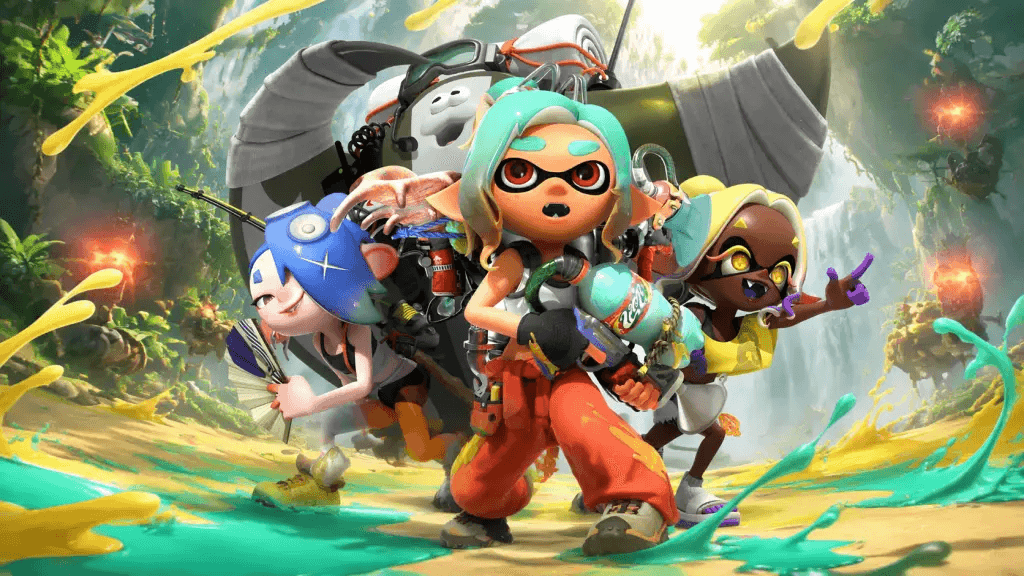
Nintendo’s Splatoon series has always been defined by fast-paced multiplayer battles, but Splatoon Raiders takes the franchise in a completely different direction. Instead of competitive matches, Nintendo’s first major Splatoon spin-off transforms the series into an action RPG built around customization, experimentation, and progression.
The result is a surprisingly deep adventure that expands on the strengths of Splatoon 3 while introducing a new gameplay loop centered around crafting builds, upgrading abilities, and overcoming increasingly difficult challenges. With its smart design and excellent pacing, Splatoon Raiders delivers the strongest single-player campaign the series has seen so far and stands among the most impressive early titles on Switch 2.
Set after the events of Splatoon 3, Raiders follows the trio of idols Shiver, Frye, and Big Man as they travel to the remote Spirhalite Islands in search of treasure. Their mission is tied to helping repay Splatsville’s enormous debt, leading them into battles against waves of Salmonid enemies while uncovering valuable relics.
While the story expands the world of Splatoon, the biggest achievement comes from how naturally the setting supports the game's central theme: making the most of limited resources.
Players take control of the Mechanic, a customizable Inkling or Octoling who specializes in crafting. All 11 weapon categories from previous Splatoon games return, but they receive a new visual identity. Rather than the polished, toy-like designs seen in the main series, weapons in Raiders look improvised and handmade, featuring unusual materials such as recycled objects and everyday items.
That creative approach extends into the game's biggest new system: Gadgets.
Unlike traditional weapons, Gadgets function as specialized abilities that define a player's build. They are divided into three categories based on the equipped ink tank: Speed, Power, and Tactical.
Speed-focused Gadgets emphasize movement and mobility, allowing players to escape danger or quickly reposition. Power Gadgets are designed around direct damage, letting players aggressively eliminate enemies. Tactical Gadgets focus on strategy and battlefield control, offering tools such as Bombloons that create linked explosions across the battlefield.
The strength of the system comes from its flexibility. Players can equip multiple Gadgets simultaneously and combine abilities to create unique playstyles. A mobility-focused setup can turn movement abilities into an advantage, while a tactical build can allow players to rely almost entirely on Gadgets rather than their main weapon.
As players progress, each Gadget can be upgraded with additional skills, opening up even more customization options. The constant cycle of discovering new abilities, improving equipment, and testing new combinations becomes the foundation of Raiders’ addictive RPG loop.
The only major weakness in this system is the crafting interface, which lacks a proper wishlist feature for tracking required materials. Managing upgrade resources can become unnecessarily inconvenient during longer sessions.
A Challenging Campaign Built Around Experimentation
Splatoon Raiders succeeds because its difficulty encourages creativity rather than repetition. The Salmonid enemies are aggressive and overwhelming, forcing players to carefully consider their equipment and approach before entering battles.
The game offers three difficulty settings, with higher levels increasing the damage players receive rather than changing enemy placement or rewards. This allows different players to experience the same campaign while adjusting the challenge level to their preference.
Failure is also an important part of progression. Losing a mission does not simply mean repeating the same content; instead, players are encouraged to return to their base, adjust their build, upgrade abilities, and try again with a new strategy.
The campaign’s pacing is one of its strongest qualities. Players consistently become more powerful, but enemy encounters continue to introduce new challenges that prevent the experience from becoming repetitive.
Rather than relying on endless grinding, Raiders constantly introduces new stage types and objectives.
The game features several mission formats, including traditional combat stages, multi-floor challenges, resource gathering missions, and specialized encounters that require players to think carefully about which tools they bring into battle.
The standout missions are the Sampler Dungeons, which function similarly to puzzle challenges from The Legend of Zelda: Breath of the Wild. Each dungeon focuses on a specific Gadget, providing players with a powerful version of the ability and designing puzzles around its mechanics. These stages effectively teach players how to use their tools while encouraging experimentation.
A Stronger Single-Player Experience Than Multiplayer
Although Splatoon Raiders supports online co-op for up to four players, the campaign is arguably at its best when played solo.
The game's handcrafted levels often function like puzzles, requiring players to carefully manage enemy encounters and choose the right abilities. Adding additional players can make some challenges easier by increasing firepower, reducing the strategic pressure that makes solo play interesting.
That does not mean multiplayer is poorly designed. In fact, Raiders introduces several improvements that make cooperative play smoother than previous Splatoon games.
Players earn their own loot, receive individual rewards, and benefit from level scaling that adjusts enemy difficulty based on each player's progression. This allows friends with different levels of experience to play together without one player completely overpowering the experience.
The endgame also provides additional challenges, stronger customization options, and more difficult missions for players who enjoy long-term progression. While it may not become a game that players return to forever, it offers plenty of additional content for those who enjoy refining builds and experimenting with new strategies.
Verdict
Splatoon Raiders successfully transforms Nintendo’s colorful shooter franchise into a surprisingly deep action RPG.
Its excellent Gadget system, creative customization options, challenging encounters, and consistently strong pacing make it one of the best single-player experiences in the series.
While the crafting interface could be improved and some visual environments lack the vibrant style associated with Splatoon, these issues are minor compared with the strength of the overall design.
By combining the personality of Splatoon with the addictive progression systems of an RPG, Splatoon Raiders delivers a fresh direction for the franchise and proves that this world has far more potential beyond competitive multiplayer.