
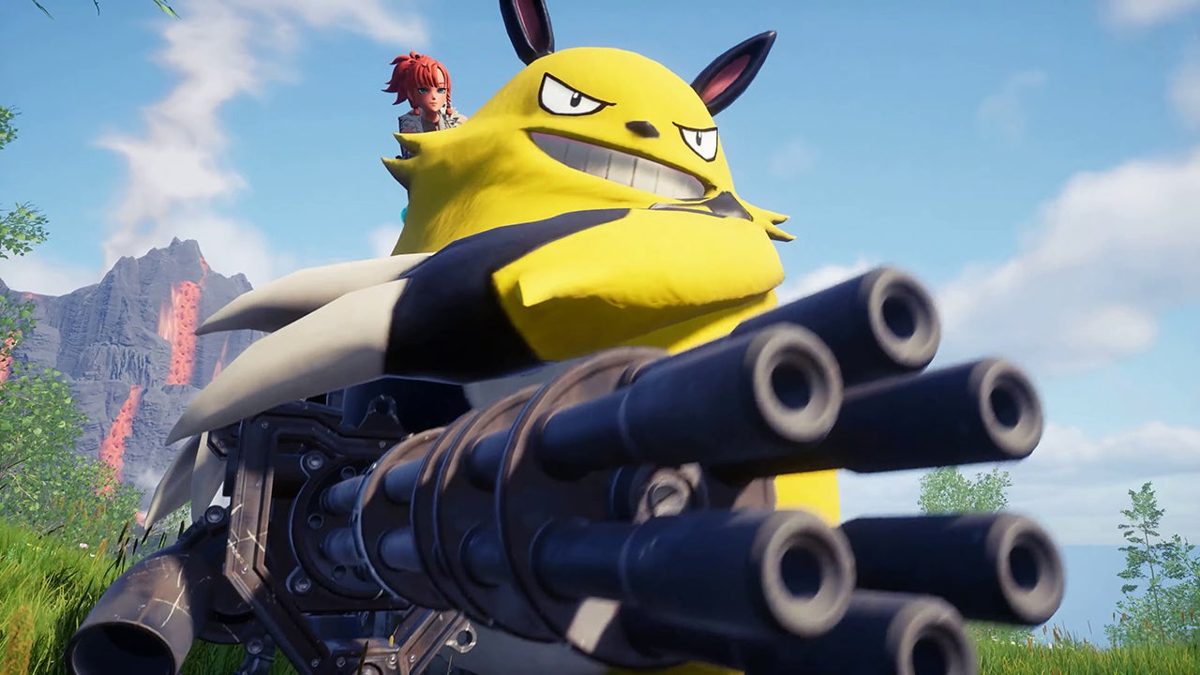
Nintendo’s legal clash with Palworld creator Pocketpair may end with far less financial impact than many expected. According to one IP expert, even a win for Nintendo in Japan could translate to a payout of only around $30,000, while any court-ordered action affecting the game’s current build appears increasingly unlikely.
The dispute between Nintendo, The Pokémon Company, and Pocketpair is focused on patents tied to gameplay systems associated with Pokémon titles, not on copyright claims over creature designs. That distinction has been one of the most notable aspects of the case, especially after the lawsuit in Japan became public. In its original form, the suit sought 5 million yen each in damages, along with late payment penalties and an injunction against Palworld.
That legal fight has unfolded in the shadow of Palworld’s explosive rise. The survival game launched on Steam and joined Game Pass on Xbox and PC in early 2024, quickly becoming one of the year’s biggest breakout hits. Pocketpair CEO Takuro Mizobe even said the studio was overwhelmed by the scale of the profits, noting in an earlier report that the team struggled to handle the sudden windfall. Since then, Pocketpair has also partnered with Sony to create Palworld Entertainment and later brought the game to PS5.
Why the Case May Matter Less Now
After Palworld drew widespread attention, comparisons to Pokémon became impossible to ignore. But rather than taking the copyright route many observers expected, Nintendo and The Pokémon Company chose to build their challenge around patent claims. Since then, however, the shape of the case appears to have shifted.
Writing on Games Fray, IP expert Florian Mueller argued that the plaintiffs revised their claims late last year, narrowing the case so it now appears to target older versions of Palworld rather than the game as it exists today. In his view, that change strongly suggests Pocketpair’s updates have already reduced the practical reach of the lawsuit.
“We cannot see any pathway to victory over any current or very recent Palworld version (nor Palworld 1.0, which should launch soon) for Nintendo. There will be no injunction with real-world impact.”
If that reading is correct, the legal battle starts to look much smaller in commercial terms. Mueller’s assessment is that even a successful result for Nintendo against those earlier builds would still cap out at 5 million yen, or roughly $30,000.
“That is chump change for either party, and just a rounding error compared to Nintendo’s litigation expenses.”
How Palworld Changed Under Pressure
Pocketpair has already acknowledged that legal pressure influenced the game’s design changes. In November 2024, patch v0.3.11 removed the ability to summon Pals by throwing Pal Spheres, replacing it with a static summon beside the player. At the time, the studio said avoiding those changes would have caused “an even greater deterioration of the gameplay experience for players.”
That was not the only adjustment. In May of the following year, Pocketpair altered the game again so gliding was handled with a glider instead of using Pals directly. The developer described those revisions as compromises made to reduce the risk that an injunction could interfere with the game’s ongoing development or sales.
“We understand that this will be disappointing for many, just as it is for us, but we hope our fans understand that these changes are necessary in order to prevent further disruptions to the development of Palworld,” Pocketpair said.
Those changes are central to Mueller’s argument. He contends the possible damages period is now narrow because Nintendo filed divisional patent applications only after Palworld had already launched in January 2024, while Pocketpair later adjusted the contested mechanics in November 2024.
“Even if we assume, for the sake of the argument, that there was some infringement in 2024, it was a short period, the sales volume was limited, and Nintendo cannot recover damages on worldwide sales in Japan: a Japanese patent is valid only in Japan, like a U.S. patent is valid only in the United States,” Mueller said.
“This litigation is no longer about anything serious in commercial terms. It’s about a hypothetical injunction that doesn’t apply to current product versions and (if anything) a small damages award for a period during which Pocketpair generated limited new sales in Japan.”
What to Watch Next
Mueller also noted that Nintendo could, in theory, attempt new action in other territories, though he pointed to the difficulty of securing game-rule patents in major jurisdictions. That challenge was underscored in April, when the USPTO rejected Nintendo’s “summon character and let it fight” Pokémon patent in a non-final decision.
As things stand, the Japanese court is scheduled to hear evidence on October 1 and is expected to express an opinion on November 9, 2026. At the same time, Palworld 1.0 is drawing closer, with IGN reporting a July 10 release date.
Source: IGN Southeast Asia. Article by Wesley Yin-Poole.